Football Dot Fun made CT realize you can literally make money just by "knowing ball."
Football Dot Fun was the topic of Crypto Twitter recently.

The platform's performance metrics were remarkable. On August 24 alone, the platform hit 113,234 transactions from 13,774 traders, with a record daily volume of $15.8 million. Its market cap jumped from $20M to $150M, almost an 8x move in just 48 hours.

Soon after, screenshots of profits flooded the timeline, as CT realized you could literally make money just by "knowing ball."
The Evolution Story
Football Dot Fun didn't appear out of nowhere. To understand why it clicked, let's rewind through the evolution of sports, fandom, and token experiments in web3.


2021: NBA Top Shot
NBA Top Shot was one of the first mainstream NFT applications, showing how sports fandom could be packaged as digital collectibles. Instead of marketing them directly as NFTs, the platform branded its highlight reels as "Moments", making the concept more approachable to newcomers.
It went viral in 2021, even before Bored Apes, fueled by the excitement of ripping open digital packs and backed by the NBA's official partnership. Collectors could also win real-world perks like signed jerseys, autographed merch, or even an all-expenses-paid trip to the NBA Finals, an early example of utility tied to NFTs. At its peak, Top Shot generated $230 million in monthly sales and proved that digital sports collectibles could capture mainstream attention. But once the hype cooled and utility remained limited, trading volumes collapsed by more than 90 percent.

2022: FIFA World Cup wave
The 2022 FIFA World Cup sparked a new wave of experimentation at the intersection of sports and crypto. Algorand partnered with FIFA to launch FIFA+ Collect, an NFT platform that offered real-world perks such as match tickets and official merchandise. Ultimate Champions introduced fantasy football mechanics, where NFT player cards earned tokens based on actual match performance. Binance rolled out Cristiano Ronaldo NFT collections, while Chiliz expanded its fan token ecosystem.
Earlier, in 2019, Sorare had already pioneered this space by combining traditional fantasy sports with blockchain technology, proving there was demand for sports gaming onchain.

2023: Friend.tech
Friend.tech became the breakout app that introduced SocialFi, a new category where social influence itself could be tokenized and traded. The idea was simple: Friend.tech used "keys" (was named as shares initially) as liquid assets that tied value directly to creators and their communities.
Launched on Base in August 2023, the app let each creator issue their own keys, which followed a bonding curve so prices rose as more people bought in. This meant not everyone paid the same price for the same key. Key holders gained access to private chats with the creator, often used for sharing alpha or exclusive content. Both the platform and the creator earned royalties on every trade, which encouraged creators to actively engage with their holders.
Friend.tech quickly became one of the most successful SocialFi experiments on Base, showing how attention and access could be financialized. However, the hype faded after its token airdrop. The FRIEND token kept dropping as recipients rushed to sell, with the largest airdrop winner dumping their entire allocation within hours. This triggered doubts about sustainability and left the platform struggling to regain momentum.
Fun Fact: Between May 3 and June 8, 2024, Machi Big Brother bought 8.6M FRIEND for $15.6M, but at today’s price they’re worth just $742K.

2024: Fantasy Top
Fantasy Top was a SocialFi project that also pioneered the concept of InfoFi, where information and engagement were financialized. In the form of NFTs, the platform turned Crypto Twitter itself into a trading card game, replacing sports highlights or private creator chats with influencer cards.
Launched on Blast in May 2024 during the Blast Gold farming craze, the app let players buy NFT cards representing CT KOLs. These cards earned points based on real Twitter engagement metrics. Players built teams of influencers and competed in tournaments, with rewards tied to how much engagement those influencers generated. It was essentially Football Dot Fun for crypto, except the "players" were influencers instead of athletes.
Fantasy Top gained huge early traction, but after Blast activity collapsed and its founder Pacman went silent, the project pivoted. It briefly partnered with Monad for a launch initiative before migrating to Base in July 2025. Despite setbacks, Fantasy Top remains one of the strongest SocialFi and InfoFi products to date.

The Shift
Earlier projects focused on NFTs, but by 2023 the trend had moved toward tokenization, riding the broader memecoin wave.
That is where Football Dot Fun enters the story. Built on Base, it combines fantasy football with tokenized players. Users can trade footballers as tokens, build squads from top leagues, and bring both playability and fun back into crypto space.
Interestingly, many of these applications and platforms now choose Base as their chain. Base offers clear advantages: transaction fees usually under $0.01, near-instant settlement, and seamless integration with Coinbase Wallet. This allows projects to tap into Coinbase's large user base while onboarding players through a familiar interface, all while preserving the decentralized nature of blockchain gaming.

What's Football.fun?
Football.fun (FDF) is where sports meet tokens. Every real-world football player becomes a tokenized asset, essentially a memecoin with the player's name as the ticker. New players are released regularly, but access depends on your in-game experience level. The higher your level, the more players you can unlock and the better entry quotes you get when buying in.
The platform blends traditional fantasy football with blockchain mechanics. A player's match stats are the biggest factor in determining their points, yet it is not a simple win-or-lose calculation.
Fame or skill alone does not drive prices. Instead, what matters most is a player's current form, health, and in-game performance. For example, a forward on a dominant team might still score poorly if they miss key chances or make costly mistakes, while an underdog player can rack up strong points through outstanding individual play. Even when a team wins, an individual's score can be penalized if their personal performance drags the overall rating down.
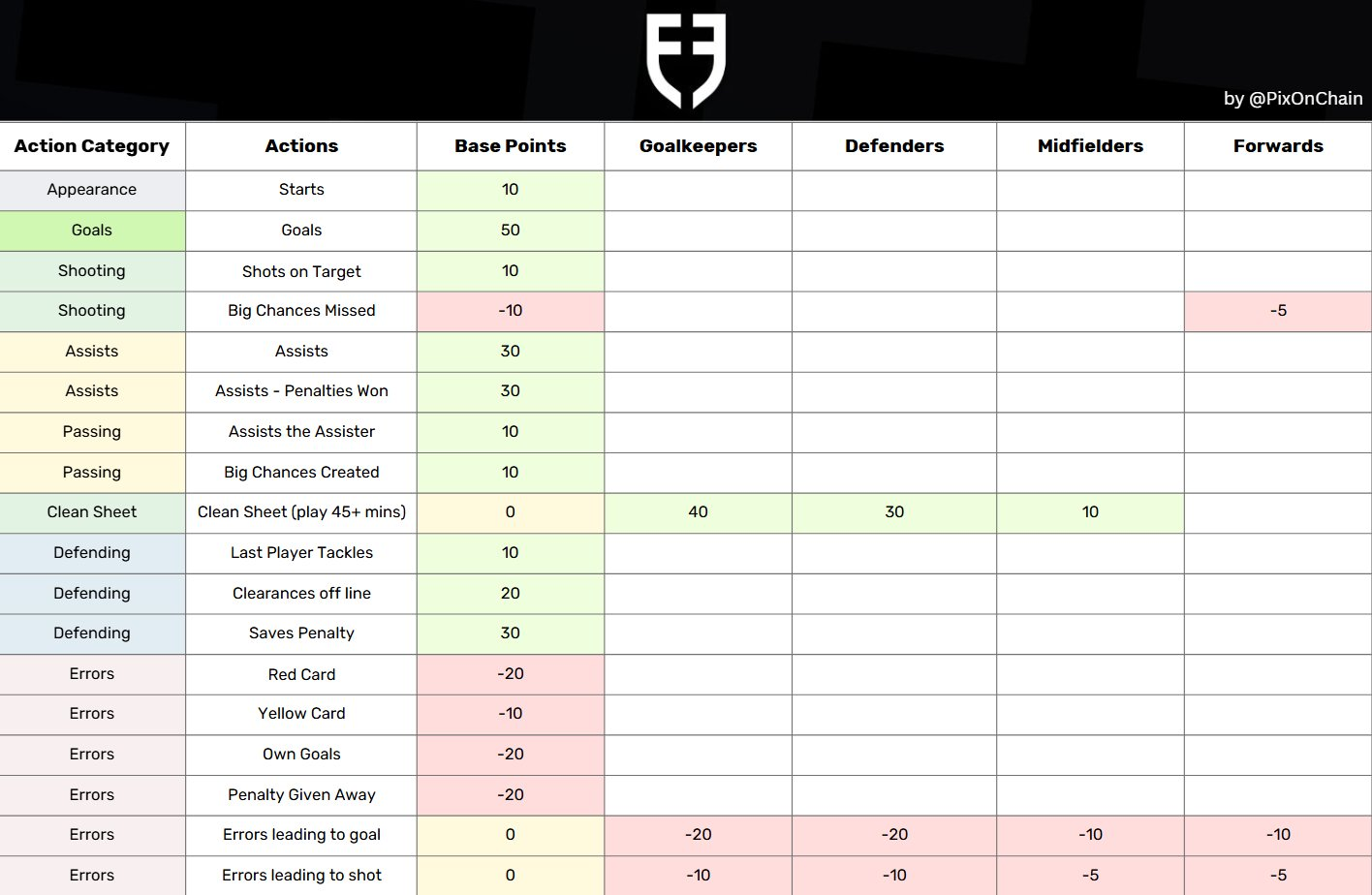
This makes FDF feel less like binary sports betting and more like a performance-based evaluation system. It is closer to horse racing combined with a performance show, where marks are given across different dimensions depending on the role you play. Just like a dressage rider in equestrian sports is judged on grace, execution, and precision beyond simply finishing the race, FDF players must "perform" across multiple metrics on the pitch.
Unlike single-league fantasy setups, FDF opens access to players across Top 5 European leagues: Premier League, La Liga, Serie A, Bundesliga, and Ligue 1.

In this sense, Football.fun is not just about holding tokens. It's about applying deep football knowledge, weighing outer factors like matchups, team strength, or even being the "weak link" in a strong side.
To put it simply, it's a fantasy football game where your football knowledge is alpha. Or, as Adam, the founder of FDF, explained it:

The Next Play
Looking back, every cycle had its "first big thing." NBA Top Shot made NFTs mainstream, Friend.tech turned SocialFi into a trend, and Fantasy Top introduced InfoFi to CT before Kaito caught the spotlight. Now it’s Football Dot Fun’s turn to prove that its mix of prediction markets, sports, and crypto can capture attention again.
It already had its exponential growth and captured CT’s attention. Now it is in consolidation mode, standing at a crossroads between cooling off or building the kind of organic growth needed to sustain momentum.
In the bigger picture, Football Dot Fun could even evolve into a form of InfoFi, not limited to CT but pulling in football fanatics from all around the world.
This is not the typical CT-style InfoFi where we recycle AI-generated content or hand out reputation points to projects that do not deserve them. Football’s version of InfoFi is every blood-pumping match played by 11 real players on each side fighting for victory.
Hardcore football fans already know these players inside out, without needing FDF to add long descriptions or flashy explanations. Just the name is enough, and maybe that's why FDF doesn't even bother to put player pictures.
The only thing FDF really needs to do is maintain organic growth and open the gate from web3 to web2, reaching the millions of fans who are already passionate about football.
For now, CT is watching, trading, and yeah, "knowing ball."

 PEPE0.00 -4.06%
 TON1.22 -2.00%
 BNB610.92 -2.82%
 SOL82.61 -4.51%
 XRP1.33 -2.91%
 DOGE0.09 -2.31%
 TRX0.31 0.00%
 ETH1989.04 -3.61%
 BTC66155.80 -3.91%
 SUI0.88 -5.50%